
Flanges
Pipe Flanges: Types, Faces and Ratings
Pipe flanges to ASME B16.5, Class 150 to 2500: weld neck, slip-on, socket weld, threaded, lap joint and blind, in five facings.
Specification
At a glance
- Dimensional standard
- ASME B16.5
- Pressure classes
- Class 150 · Class 300 · Class 600 · Class 900 · Class 1500 · Class 2500
- Types & ends
- Weld neck · Slip-on · Socket weld · Threaded · Lap joint · Blind
- Facings
- Flat face (FF) · Raised face (RF) · Lap joint (LJ) · Ring joint (RTJ) · Male & female (M&F)
- Grades
- Mild SteelIS 2062 Gr. A
- Carbon SteelASTM A105N
- Stainless SteelASTM A182 F304 / F304L / F316 / F316L
- Alloy SteelASTM A182 F11 / F22 / F91
- Also offered in
- Stainless steel
- Nickel alloys (Inconel, Incoloy, Hastelloy, Monel)
Dimension tables
8 classes · dimensions, weights, Excel
Carbon Steel
Stainless Steel
Alloy Steel
As published by Fortune Fittings Private Limited. Grade and availability are confirmed with each enquiry; confirm the governing standard, size and grade when ordering. Spotted a mistake? Please contact us.
Overview
Product overview
Pipe flanges are indispensable components in industrial piping systems, facilitating secure connections between pipes, valves, fittings, and more. In this article, we delve into the intricacies of pipe flanges, their types, working principles, materials, and applications.
How Pipe Flanges Work
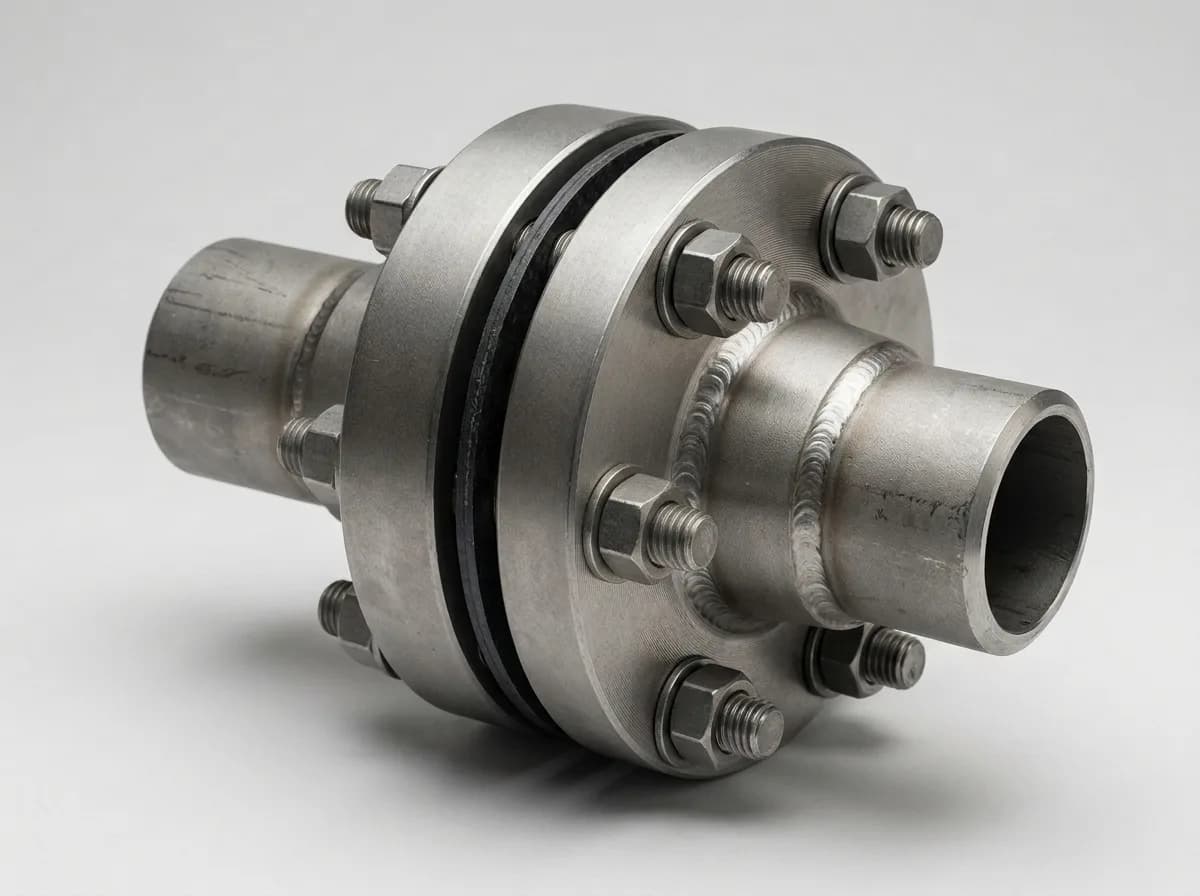
Pipe flanges work by bolting together piping components with the aid of a gasket to ensure a leak-free connection. The components of a typical pipe flange connection include the pipe itself, the flange, a gasket for sealing, bolting, and in some cases, welding.
Threaded Flange
- Joined using male and female threads.
- Suitable for low-pressure applications like water and compressed air systems.
Welding Neck Flange
- Welded to the pipe for high-pressure applications.
- Offers unrestricted flow without turbulence or erosion.
Slip-On Flange
- Secured with fillet welds on the inside and outside.
- Ideal for low-pressure, non-critical applications.
Socket Weld Flange
- Used for small-size, high-pressure pipes.
- Pipe is inserted into the flange socket and welded in place.
Lap Joint Flange
- Combined with stub ends to reduce costs.
- Ideal for connecting dissimilar materials in pipeline systems.
Blind Flange
- Seals or closes pipelines to block fluid flow.
- Allows easy access for maintenance activities.
Pipe Flange Face Variants
Pipe flanges come in various face variants, each with its unique sealing characteristics:
- Flat Face (FF)
- Raised Face (RF)
- Lap Joint (LJ)
- Ring Joint (RTJ)
- Male and Female (M&F)
Common Pipe Flange Materials
At Fortune Fittings Private Limited, we offer pipe flanges in a variety of materials, including:
- Stainless Steel
- Nickel Alloys (Inconel, Incoloy, Hastelloy, Monel)
Pipe Flange Classification and Pressure Rating
Pipe flanges are classified based on pressure ratings, ranging from 150 to 2500 according to ANSI/ASME B16.5 standards. The pressure rating determines the maximum allowable pressure a flange can withstand at varying temperatures, making it crucial to select the right flange for your application’s requirements.
Conclusion
Contact us today to explore our product range and request a competitive price list.
Related
Specified alongside this
Components that commonly appear with it on the same run, and the rest of the flanges range.
 Same rangeWeld Neck FlangeWeld neck flanges to ASME B16.5, ASME B16.47 and EN 1092, including long weld neck, with tables for MS, carbon, stainless and Cr-Mo grades.View specifications
 Same rangeSlip-On FlangeSlip-on flanges to ASME B16.5 and EN 1092-1, flat or raised face, with dimension tables for mild, carbon and stainless steel.View specifications
 Same rangeBlind FlangeBlind flanges to ASME B16.5, ASME B16.47, BS 4504 and EN 1092-1, 1/2″ to 48″, with tables for MS, carbon, stainless and Cr-Mo grades.View specifications
 Same rangeSocket Weld FlangeSocket weld flanges to ASME B16.5 and BS 4504 for small-bore, high-pressure lines, in stainless and carbon steel, with Class 150 tables.View specifications
 Same rangeThreaded FlangeThreaded flanges to ASME B16.5 with NPT or BSP threads for low-pressure lines where welding is not wanted, with Class 150 tables.View specifications
 Same rangeLap Joint FlangeLap joint flanges to ASME B16.5, EN 1092-1 and DIN 2642, used with a stub end, Class 150 to 600, with Class 150 dimension tables.View specifications
Where it is specified
Industries using this component
Sectors that commonly specify the Pipe Flanges, and what else they take from us.
Enquiries
Need a quotation for the Pipe Flanges?
Send sizes, grades, quantities and the standard the component is specified to, and a sales engineer will come back with availability and pricing. Dimensions and schedules are in the Technical Catalog.